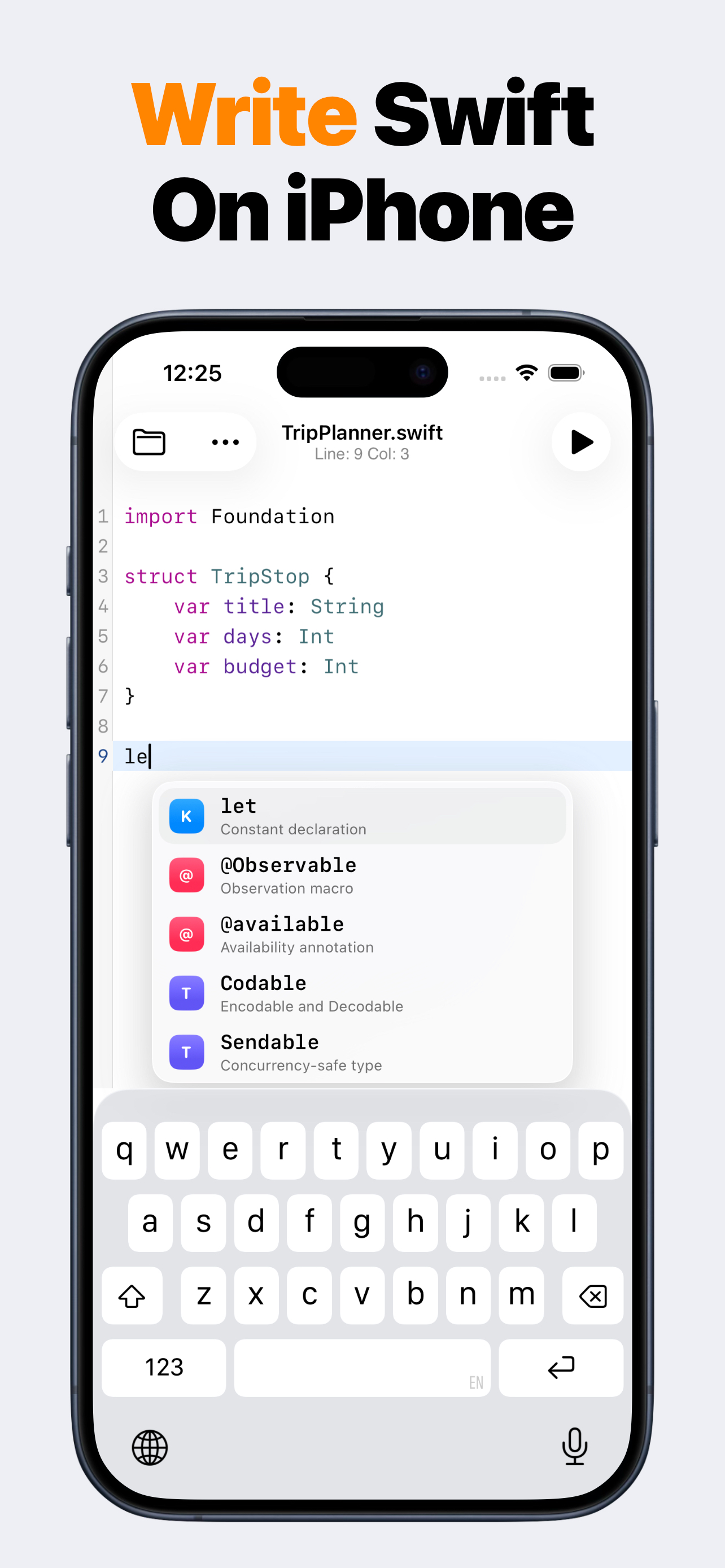
SwiftMate editor for practicing Swift code on iPhone

Swift practice anywhere

Learn Swift on iPhone by running code

SwiftMate helps you learn Swift through short, repeatable coding practice on iPhone. Bring an exercise, type or import the solution, run it, read the output and diagnostics, and save the useful version. The app is a practice environment, not a built-in course or Xcode replacement.

iPhone + iPad Swift editor Console + diagnostics

Turn a concept into a working snippet

Reading syntax is useful, but writing and running a small program exposes the details you did not yet understand. Use one SwiftMate file per concept: optionals, collections, functions, protocols, Codable, concurrency syntax, sorting, recursion, or any exercise from your course or interview plan.

Run early. A compiler diagnostic gives you a concrete problem to solve, while successful output lets you compare the program with the result you expected. Duplicate the file before changing the approach so both versions remain available.

  • Swift syntax exercises
  • Algorithms and data structures
  • Interview practice
  • Foundation experiments
  • Reusable custom snippets
  • Compiler-guided corrections

SwiftMate is the workspace, not the lesson plan

SwiftMate does not claim to replace a structured course, teacher, official documentation, or Apple's guided Swift Playgrounds lessons. It gives you the editor, runner, console, diagnostics, files, and snippets needed to practice material from those sources on an iPhone.

Keep exercises small and focused on one idea. When a lesson depends on SwiftUI previews, an iOS Simulator, device frameworks, packages, tests, or a complete app project, continue in the environment required by that lesson.

Save examples you will want again

Organize files by topic, rename them clearly, and keep a known-working version before experimenting. Custom snippets can reduce repeated typing for patterns you use often, while import and export tools let you move examples into a larger project later.

The goal is not to finish an app on the phone. The goal is to make Swift syntax and problem solving easier to practice whenever a short session is available.

Run and AST actions require internet access because SwiftMate uses a hosted Swift backend.

SwiftMate FAQ

What is SwiftMate?

SwiftMate is a Swift code editor and hosted runner for iPhone and iPad. Use it to write short Swift programs, organize files, run snippets, read console output and compiler diagnostics, and inspect code structure without opening a Mac for every small experiment. Learn more about SwiftMate.

Can SwiftMate run Swift code on iPhone?

Yes. Write or import a Swift snippet, tap Run, and SwiftMate sends the code over HTTPS to its configured Swift runner. The result returns to the in-app console with output, exit status, duration, and diagnostics when available. Learn more about running Swift code.

Does my Swift code stay on the device?

Files stay local while you edit and organize them. When you choose Run or AST, the source and optional input must be sent to the runner backend for compilation or inspection. Source code and console contents are excluded from product analytics and crash-report parameters. Learn more in the SwiftMate FAQ.

Does SwiftMate replace Xcode?

No. SwiftMate is built for snippets, exercises, algorithms, and fast experiments. It does not build or sign complete iOS apps, run an iOS Simulator, show live SwiftUI previews, archive projects, or submit apps to App Store Connect. Compare SwiftMate and Swift Playgrounds.

Can I use SwiftMate on iPad?

Yes. SwiftMate supports iPad with a wider editor layout, file navigation, completion suggestions, console output, and the same core snippet workflow available on iPhone. Learn more about SwiftMate on iPad.

What does SwiftMate Premium add?

Premium can unlock broader run access, image-to-code import, custom snippets, pro editor fonts, additional Swift versions, and AST inspection. Exact products, prices, quotas, and availability can vary, so check the current App Store offer before purchasing. Learn more in the SwiftMate FAQ.